The Morning Sales Brief.
How a security-services firm gave its sales team back the first hour of every day — and stopped letting warm leads slip away.
Told without names

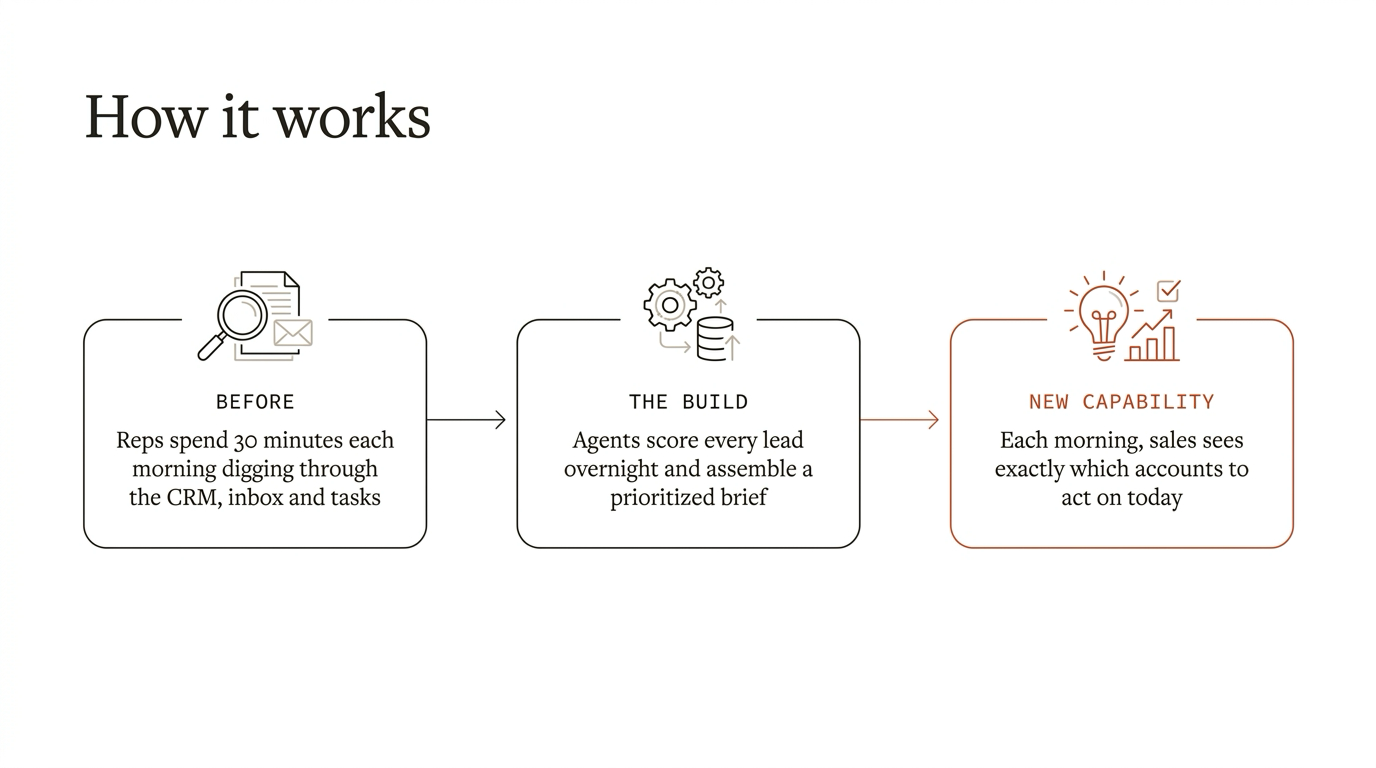
A lean sales team at a security-services firm had a quiet, expensive problem hiding in plain sight. Every morning began the same way: each rep opened the CRM, the inbox, and the task board, and spent the better part of half an hour piecing together a picture of where to spend the day. The information was all there. It just never arrived assembled.
The challenge
Thirty minutes of digging, multiplied across the team, every day, is a real cost on its own. But it was the symptom, not the disease. The real problem was that the reps were doing a job software should do: scanning everything, holding it in their heads, and guessing at priority before the day had even started.
And because it depended on a human noticing, things slipped. An account that had gone quiet. A prospect who had just shown intent. A renewal creeping up on the calendar. By the time anyone connected the dots, the moment had often passed — and nobody could even see the ones that got away.
Our approach
We started where the team already worked, connecting the CRM, email, and the task board rather than asking anyone to adopt a new tool. Overnight, an agent scores every lead on freshness and signal — recent activity, engagement, contract timing, how long since the last touch.
Each morning, it turns those scores into a single prioritized brief: who to contact today, and why, in plain language, with the context attached. Nothing sends on its own — the rep still decides. The agent just makes sure the right accounts are the first thing they see, already ranked, with a reason beside each one.
The team now starts the day knowing exactly which accounts are ready to move — including the ones they would never have spotted in time.
That last part is the real shift. It is not that the work got faster. It is that work which used to be invisible now shows up, ranked, before the first coffee — and a warm lead that would once have gone cold gets a call while it is still warm.
It talks back — and it learns
The brief is not a memo the rep reads and closes. It is the start of a conversation. They can ask the agent why an account surfaced, pull more context on a contact, or send it to do a quick piece of research before a call — and get the answer in the moment, not after an hour of digging. The rep walks into the day with exactly the picture they need, not just the one the agent guessed at.
And it runs both ways. When a rep notices something the agent missed — a signal that turned out not to matter, a lead that was hotter than it looked — they tell it, right there in the thread. The agent writes that down. Every correction becomes a rule it carries forward, so tomorrow's brief is a little sharper than today's. The system does not just run; it compounds. The longer the team uses it, the more the brief reads like their own best rep wrote it.
The result
The first hour of the day went back to selling instead of sorting. More importantly, the team stopped relying on memory to catch the moments that matter — the briefing does it for them, every morning, without fail.